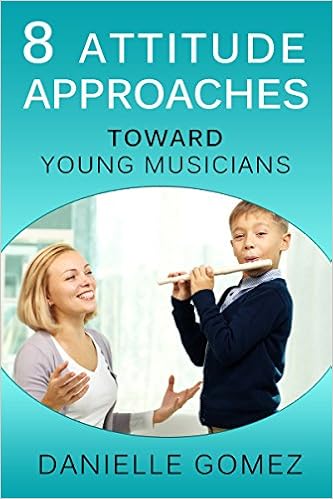
8 Attitude Approaches Toward Young Musicians


Learning to play a musical instrument well can very likely be the biggest challenge someone ever faces. Many skills require coordination or focus but very few demand the same level of commitment and time. Learning how to play an instrument takes years, arguably even decades in order to master.

During this passage of time people will naturally change as life teaches new lessons. These changes can create friction as a student progresses and the difficulty of the musical material also increases. Therefore it is important to be able to take a step back in order to approach the instrument with an open-minded healthy attitude.

Until the child is old enough to responsibly handle productive practice sessions on his own, much of his success will depend on the parent’s persistence. The purpose of this booklet is to present eight attitude approaches that would be useful for both new parents whose child is just starting music lessons and veteran parents that have to readdress how practicing is being approached now that child has become older.

Since so much depends on the parents in the early stages of music lessons, it is important that their needs are addressed along with the student’s. Learning to recognize the true source of practice session conflicts is just as critical as learning how to tune.

This booklet is available for purchase on Amazon and most other major ebook retailers.

Comments

Popular posts from this blog

Interview with Michiko Yurko on Music Mind Games and Sight-Reading in the Suzuki Method

Welcome to Rethinking Genius, Michiko! Please introduce yourself and tell us about your company, Music Mind Games. Hi, Danielle! I am Michiko Yurko and I am the creator of Music Mind Games, a project I have been working on for 40 years. It’s been great! Music and education were important to my parents. Although they followed different professions, my father sang and my mother played the piano. I was always supported in my music and dance lessons and related activities so I have very positive memories of those years. My mom was an elementary classroom teacher and her extraordinary devotion to her students and her creativity taught me to be innovative in my own work. Music Mind Games, LLC was founded in 2005 after Warner Bros (my publisher for nearly 20 years) was sold to Alfred. Although they believed in my work and continue to publish the book Music Mind Games, Alfred said they could not afford to produce the Music Mind Games materials. My husband, Cris and I discussed all sor...

Like Brushing Your Teeth

One of my teacher trainers told me that practicing should be like brushing your teeth. There is never a day when your tooth brushing is affected by other events in your day. The process is completely emotionally detached. I mulled over her words of wisdom for quite some time after she said them to me. What struck me the most was the suggestion of emotionally detaching myself. All my life I have been told that music is supposed to express emotion. So it was almost like it would be wrong to try and strip that away. For me, the teeth brushing example was a very interesting concept. I realized that the level of habitual repetition of that daily routine is rarely achieved in any other life areas. Dishes get put off, vacuuming, shopping for groceries.... but I always make the time to brush my teeth. Always making the time for practice? A lofty ideal indeed.

Interview with Dr. Molly Gebrian on the Neuroscience Behind Block vs. Random Practice

Welcome to Rethinking Genius, Molly! Can you tell us a little about your background in teaching and neuroscience? Thank you for inviting me to do this, Danielle! I was a Suzuki kid myself (I studied with David Einfeldt at the Hartt Suzuki Institute from the time I started at age 7), and I’ve done some Suzuki teacher training, but these days, I’m a college professor teaching at the University of Wisconsin-Eau Claire. I’ve been teaching for about 15 years, from 4-year old beginners, all the way up through graduate students. As far as neuroscience goes, I was a double-degree student at Oberlin College and Conservatory, majoring in viola performance and neuroscience. I had no plans to continue with neuroscience (it was just something I found fascinating, that I did for fun!), but when I got to New England Conservatory of Music for grad school, something was missing. My roommate at NEC, who had also been at Oberlin with me, participated in a study at Harvard looking at musicians’ versus ...